
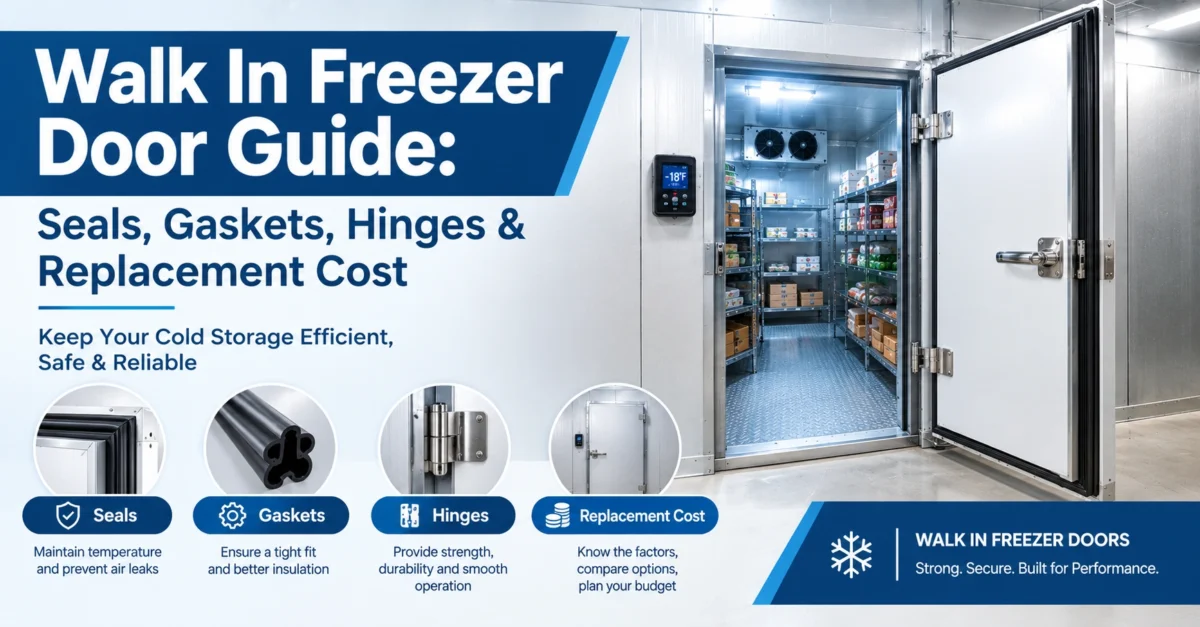
That is why the door is where nearly every walk in freezer problem starts. Frost on the frame, a compressor that will not cycle off, ice on the floor by the threshold: the door is the first place to look. This guide covers each component of a commercial walk in freezer door, how to tell which one has failed, and what drives the cost of a replacement. Replacement hardware is stocked under Parts and Accessories in the Coolers and Freezer range at Store Display Fixture in Dallas, TX.
Why the walk in freezer door is the hardest working part of the system
A walk in freezer holds between -10 degrees F and 0 degrees F. A walk in cooler holds between 35 degrees F and 45 degrees F. The room outside is usually near 70 degrees F, so a freezer door manages roughly twice the temperature difference a cooler door does, with the added problem that moisture getting past the seal does not condense, it freezes.
Every opening pulls warm, humid air into the box, and the system has to remove that heat and moisture again. A door that seals makes this brief and recoverable. A door that does not makes it continuous. Heavy-duty doors and seals are standard across the walk in cooler and freezer range for that reason, alongside high-density insulated panels. Panels last the life of the box; gaskets, hinges, closers and heaters wear on a schedule set by traffic.
The parts of a walk in freezer door
A commercial walk in freezer door is an assembly, not a single object. Knowing which piece is which is the difference between replacing a small part and replacing the whole leaf.
Walk in freezer door seal and gasket
The walk in freezer door gasket is the flexible perimeter strip that compresses when the door shuts, closing the gap between leaf and frame. It is the most replaced part on any walk-in, and the one that fails most quietly.
A gasket fails by hardening. New material springs back after every close; after a few years of cold cycling it stiffens and leaves gaps at the corners even when the door looks shut. It can also tear where a cart catches it or pull out of its retaining channel.
The test takes ten seconds. Close the door on a strip of paper so half hangs outside, then pull. If it slides out with almost no resistance, the walk in freezer door seal is not compressing at that point. Repeat every foot around the perimeter and along the bottom. Corners fail first, because that is where the gasket has to bend.
Walk in freezer door hinges
Most commercial walk in freezer door hinges are cam-lift hinges. They raise the door slightly as it opens and let its own weight pull it down onto the seal as it shuts, and that drop is part of how the gasket gets its compression.
When hinges wear, the door sags, stops meeting the frame squarely, rubs at the bottom corner and leaves a gap at the top. If you have to lift or shoulder the door to latch it, the hinges have gone, and a new gasket will not fix the leak because the door is no longer landing where the gasket sits.
Walk in freezer door heater
This component is unique to freezers and most operators do not know it exists. A walk in freezer door heater is a low-wattage resistance wire run through the frame, sometimes through the threshold. It does not heat the box; it keeps the frame just above the point where moisture would freeze on contact.
Without it the frame collects frost, then ice, and the door either freezes shut or gets forced open hard enough to tear the gasket. A cooler frame never gets that cold, so a cooler door does not carry one. A ring of frost around the frame, or a door sticking shut in the morning, usually means the heater has failed rather than the gasket. That fault is often mistaken for a refrigeration problem, and money gets spent chasing the compressor first.
Walk in freezer door closer
A walk in freezer door closer pulls the door shut after someone walks through with both hands full. It is the part standing between normal operation and a door left open through a rush. Closers weaken gradually, and one that no longer pulls the door fully into the seal is worse than none, because the door looks closed and is not. Watch it close from full open; if it stops short of latching, replace it.
Walk in freezer door handle and latch
The walk in freezer door handle and latch assembly pulls the door into the gasket and holds it there. Commercial latches use a cam action, so turning the handle draws the door tight rather than simply holding it shut. Adjustment matters: set too loose it will not compress the seal, set too tight it crushes the gasket flat and shortens its life.
Every commercial walk in freezer door latch must have a safety release on the inside so anyone in the box can get out even when the outside handle is latched or padlocked. Check it as part of routine inspection, and never fit a latch assembly without one.
| Tier | Rack model | Facing capacity | Price | Payback |
|---|
Door sweep, threshold and strip curtains
Cold air falls, so the bottom of the door is where it escapes. A door sweep closes the gap between the leaf and the threshold plate. The threshold takes the heaviest abuse on the assembly since every cart rolls over it, and a worn one holds the door off its seal along the whole bottom edge. Walk in freezer strip curtains hang inside the opening and hold back most of the air exchange while the door is open, taking load off both the gasket and the heater.
Signs a walk in freezer door needs attention
Door failures announce themselves well before the temperature alarm does. Watch for these:
- Frost or ice building up around the door frame, which usually points to the door heater rather than the gasket
- A visible gap at the top or bottom corner when the door is fully latched, which points to sagging hinges
- The dollar bill test pulling free with no resistance anywhere along the perimeter
- A door that has to be lifted, shouldered or slammed to latch
- Ice on the floor just inside the doorway, which points to the sweep or the threshold
- A compressor running continuously without cycling off, with no other fault present
- A closer that stops short of pulling the door into the latch
A failing gasket is a cheap fix caught early and an expensive one ignored, because a leaking door loads the refrigeration system every hour it stays that way.
Walk in freezer door replacement: repair or replace the whole door?
Most of the time, walk in freezer door replacement means replacing a component, not the door. Know the hierarchy before you get a quote.
| Symptom | Usual cause | Scope of work |
| Air leaking, gasket hard or torn | Worn gasket | Gasket only |
| Door sags, rubs, gap at top corner | Worn cam-lift hinges | Hinges, then re-check gasket |
| Frost ring on frame, door freezing shut | Failed door heater | Heater wire |
| Door does not self-close fully | Weak closer | Closer |
| Door will not pull tight when latched | Latch out of adjustment or worn | Latch adjustment or replacement |
| Cold air spilling at floor level | Worn sweep or damaged threshold | Sweep, threshold plate |
| Panel delaminated, core wet, leaf warped | Structural failure of the door | Full door replacement |
Full replacement is warranted when the leaf itself has failed: the core has taken on moisture, the skin has separated, or the leaf has warped beyond what hinge or latch adjustment can correct. On an older or non-standard box, a replacement leaf and frame can be built to the existing opening rather than rebuilding the surrounding panels. Custom walk-in coolers and freezers are fabricated in-house under the Custom Carpentry line, which is what makes building to an existing opening practical. See the custom walk-in freezer and custom walk-in cooler lines for that work.
Commercial walk in freezer door replacement cost: what drives the number
There is no single figure for commercial walk in freezer door replacement cost, because the phrase covers everything from a length of gasket to a complete insulated door and frame. These variables decide where a quote lands:
- Scope. A gasket, a hinge set, a closer or a heater wire are individually inexpensive parts. A full door leaf and frame is a different order of cost entirely.
- Freezer or cooler. A freezer door carries a heater circuit and heavier insulation that a walk in cooler door does not, so the same nominal size costs more on a freezer.
- Opening size, door type and fit. A hinged personnel door, a glass display door and a sliding door are three different builds, and a door matching a standard opening is a stocked configuration where a non-standard opening is fabricated to measure.
- Hardware and corrective work. Kick plates, hasps, viewing windows and strip curtains are specified separately, and a sagging door often means the frame has been pulled out of square, which has to be corrected or the new door fails the same way.
Acting early is the cheaper path. A leaking door runs the system harder every trading hour, and that cost accumulates quietly in a way a one-time parts cost does not. For current pricing, contact the Dallas team at 361-339-0323 with the opening dimensions and whether the unit is a cooler or a freezer.
Walk in freezer doors compared with walk in cooler doors
The two look similar and are not interchangeable. A cooler door is built for a 35 degrees F to 45 degrees F room where condensation forms but ice does not. A freezer door is built for -10 degrees F to 0 degrees F, where any moisture reaching the frame freezes.
| Feature | Walk in cooler door | Walk in freezer door |
| Room temperature | 35 to 45 degrees F | -10 to 0 degrees F |
| Frame heater | Not required | Required |
| Threshold heater | Not required | Common on heavy-traffic units |
| Insulation thickness | Lower | Higher |
| Gasket duty | Condensation resistance | Ice resistance and cold-set recovery |
| Glass door option | Common, for merchandising | Limited, heated glass required |
This is also why a cooler cannot simply be turned down to freezer temperature. Where an operation needs both, combination cooler-freezer units provide refrigeration and freezing in a single installation using dual temperature zones, and each zone gets the door specification its temperature requires. Beer caves, which customers enter from the sales floor, are a further case: see the beer cave line for retail-facing walk-in doors.
Walk in freezer door parts and hardware in Dallas, TX
Store Display Fixture supplies walk in freezer door parts, seals, hinges and hardware alongside complete refrigeration units from a showroom at 10793 Harry Hines BLVD #120, Dallas, TX 75220. The business holds an A+ rating with the Better Business Bureau and is reachable at 361-339-0323, Monday to Saturday, 9 am to 6 pm.
Door hardware and replacement components are listed under Parts and Accessories. Complete units are in the Coolers and Freezer, which covers free standing coolers and freezers, free standing freezers, kitchen freezers and custom builds. Installed work across restaurants, convenience stores and grocery retailers is shown in Past Projects. When calling about a door, have the opening dimensions, whether the box is a cooler or a freezer, and the symptom you are seeing ready. That is usually enough to identify whether it is a part or a door.
Order walk in freezer door parts or a complete unit
A door that seals is the cheapest energy saving available on a commercial walk in freezer, and the parts that make it seal cost little next to running a compressor against a leak for a year.
Browse Parts and Accessories for door hardware, seals and components, or the full Coolers and Freezer range for complete walk in coolers and freezers. Company background is on the About Us page, freight is covered under shipping and freight delivery, and purchasing questions are answered in the FAQ. To spec a door or a complete unit, contact the Dallas team at 361-339-0323.
Frequently asked questions
How do I know if my walk in freezer door seal needs replacing?
Close the door on a strip of paper so part of it hangs outside, then pull. If it slides out with little resistance, the gasket is not compressing there. Test every foot around the perimeter, paying attention to the corners, which fail first.
Why is my walk in freezer door freezing shut?
A frost ring around the frame and a door that sticks shut usually indicates a failed walk in freezer door heater rather than a gasket problem. The heater is a low-wattage wire in the frame that keeps it just above freezing so moisture cannot ice onto it.
What is a walk in freezer door heater and does a cooler need one?
It is a resistance wire in the door frame that stops ice forming where the cold frame meets warm room air. A freezer running at -10 degrees F to 0 degrees F needs one. A cooler at 35 degrees F to 45 degrees F does not, since the frame never gets cold enough to ice up.
Why is my walk in freezer door sagging?
Worn cam-lift hinges. They lift the door as it opens and let it settle onto the seal as it closes. As they wear the door drops out of alignment, rubs at the bottom and leaves a gap at the top. A new gasket will not fix it, because the door is no longer landing where the gasket sits.
Can I replace just the gasket instead of the whole door?
In most cases, yes. Gaskets, hinges, closers, latches, heaters, sweeps and thresholds are all replaceable individually. Full door replacement is only necessary when the leaf itself has failed.
What does a commercial walk in freezer door replacement cost?
It depends on scope, opening size, door type, whether the unit is a cooler or a freezer, and whether the door is standard or built to measure. Call 361-339-0323 with the opening dimensions for current pricing.
Do walk in freezer doors need a safety release on the inside?
Yes. Every commercial walk in freezer door should have an inside release allowing anyone in the box to open it even when latched or padlocked from outside. Check it during routine inspection and never fit a latch assembly without one.