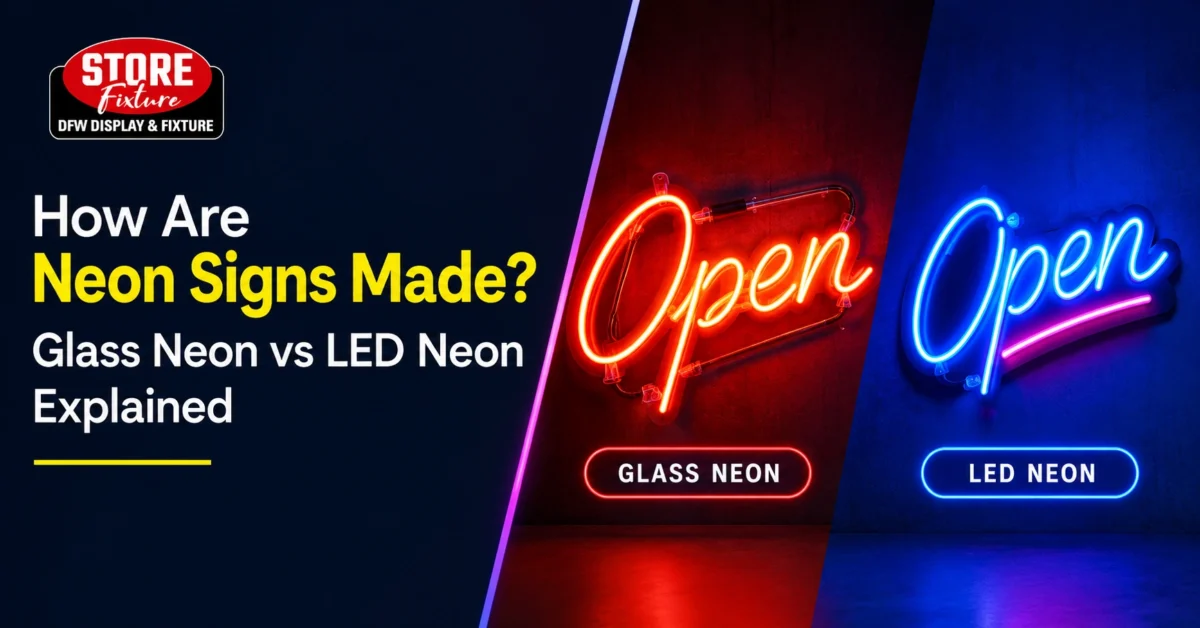
How are neon signs made? Traditional neon signs are hand-bent glass tubes, emptied of air, filled with a small amount of neon or argon gas and lit by high-voltage electricity. Modern LED neon signs copy that look with flexible strips of LEDs inside a soft diffuser, mounted on an acrylic backing and powered at low voltage.
Both styles produce the glowing lines people picture when they think of neon signs, but the way they are built, what they cost to run and how long they last are very different. This guide walks through each method step by step, explains where the colors come from and shows what goes into a custom sign, so you can understand what you are buying for a storefront, bar, salon or home.
What Are Neon Signs?
Neon signs are lighted signs made from glowing lines of light shaped into letters, logos or pictures. The original neon signs used gas-discharge tubes: when electricity passes through a sealed glass tube containing neon gas, the gas glows a warm red-orange.
The technology dates back more than a century. Neon gas was discovered in 1898 by the British chemists William Ramsay and Morris Travers. French engineer Georges Claude showed neon lighting in Paris in 1910 and went on to develop neon advertising signs, which spread to the United States in the 1920s and became a fixture of storefronts, diners and theaters.
Today the term covers two products:
- Glass neon: the traditional handmade glass tube filled with gas.
- LED neon: a modern alternative that uses LEDs inside a flexible tube to imitate the glass look.
How Glass Neon Signs Are Made
Glass neon is a craft. Each tube is bent by hand by a skilled glass bender, and a single sign can take many hours of work.
Step 1: Create the Pattern
The design is drawn full size on heat-resistant paper. Because the tube is bent from behind, the pattern is drawn in reverse. Every letter is planned as a continuous path, with sections that will later be blacked out where the tube jumps from one letter to the next.
Step 2: Heat and Bend the Glass
The bender heats a straight glass tube over gas burners until the glass softens at the exact point of the bend. Different burners heat short sections for tight curves or longer sections for gentle ones. While bending, the worker blows gently into a rubber hose attached to the tube so it keeps its round shape instead of collapsing. Each bend is laid on the pattern to check it before the glass cools.
Step 3: Attach the Electrodes
Once the shape is complete, metal electrodes are fused to each end of the tube. These are the connection points where electricity enters and leaves the gas.
Step 4: Bombard the Tube
The tube is connected to a vacuum pump to remove the air. While it is under vacuum, a high electrical current is run through it, heating the glass and electrodes to drive out moisture and impurities. This step, called bombarding, is essential. Any impurity left inside shortens the life of the sign and dulls its color.
Step 5: Fill With Gas and Seal
With the tube clean and empty, a small amount of gas is let in at low pressure. Neon produces red-orange light. Argon, usually with a tiny drop of mercury, produces blue light. The tube is then sealed off from the pump.
Step 6: Age the Tube
The finished tube is run for a period, a process called aging or burning in, so the gas and electrodes settle and the glow becomes even.
Step 7: Black Out and Mount
Sections that should not glow are painted with an opaque block-out paint. The tubes are mounted on a frame or clear backing with supports that hold them away from the surface, then wired to a neon transformer that steps household power up to several thousand volts.
Where Neon Sign Colors Come From
Only a few gases are used in glass neon signs, yet they come in dozens of colors. That variety comes from three sources:
- The gas itself. Neon glows red-orange. Argon with mercury glows blue and gives off ultraviolet light.
- Phosphor coatings. The inside of many tubes is coated with phosphor powders. Ultraviolet light from the argon and mercury makes the coating glow, producing whites, pinks, greens, purples and more.
- Colored glass. Tinted glass filters the light, deepening or shifting the color.
By combining gas, coating and glass color, a sign maker can produce a very wide range of shades.
How LED Neon Signs Are Made
LED neon signs are built in a completely different way, with no glass, gas or high voltage.
Step 1: Design the Sign Digitally
The design is created as a digital vector file. This sets the size of the sign, the path of every glowing line and the shape of the backing panel.
Step 2: Cut the Acrylic Backing
A laser cutter or CNC router cuts the acrylic backing to shape. Channels or guide lines are cut into the surface to hold the LED strips in exactly the right position. The backing can be clear for a floating look, colored, or cut to the outline of the design.
Step 3: Cut and Shape the LED Neon Flex
LED neon flex is a strip of small LEDs set inside a soft silicone or PVC jacket. The jacket diffuses the points of light into a smooth, continuous glow that looks like a glass tube. The flex is cut at marked points and bent by hand to follow each letter.
Step 4: Wire the Sections
Each section is connected with small wires, and connections are sealed so moisture cannot get in.
Step 5: Fix and Test
The strips are glued or clipped into the channels on the backing. The sign is connected to a low-voltage power adapter, usually 12 or 24 volts, and tested for even brightness. Some signs add a dimmer or a remote control to change brightness or color.
Glass Neon vs LED Neon
Both kinds of neon signs have their place. Here is how they compare:
- Look: glass neon gives a 360-degree glow with a warm, slightly uneven character. LED neon gives a very even glow and is brightest from the front.
- Durability: glass is fragile and can break in shipping or if knocked. LED neon is flexible, lighter and much harder to damage.
- Power and heat: glass neon runs on high voltage and gets warm. LED neon runs on low voltage and stays cool to the touch.
- Energy use: LED neon generally uses less electricity than glass neon of a similar size.
- Repairs: glass neon needs a specialist to re-bend or refill a tube. LED neon sections are usually simpler to replace.
- Installation: LED neon signs are light and can hang in a window or on a wall with simple fixings. Glass neon usually needs a transformer housing and careful mounting.
For most stores, LED neon offers the classic look with less risk and lower running costs. That is why most retail neon signs sold today, such as OPEN, ATM and category signs, are LED.
| Tier | Rack model | Facing capacity | Price | Payback |
|---|
How Are Neon Signs Made to Last?
Two signs can look the same on the day they arrive and age very differently. Build quality decides how long neon signs keep their glow.
What Makes Glass Neon Last
- Thorough bombarding: a tube cleaned properly before filling keeps its color and brightness far longer.
- Good electrodes and seals: weak seals let air creep in, which makes the tube flicker and eventually go dark.
- A correctly matched transformer: too much or too little power shortens tube life.
- Careful mounting: supports that hold the tube without strain protect it from cracking as it warms and cools.
What Makes LED Neon Last
- Quality LEDs and jacket: a thick, UV-resistant silicone jacket resists yellowing and keeps the glow even.
- Sealed connections: waterproofed joints and end caps stop moisture from reaching the LEDs, which matters for signs near doors or in humid spaces.
- A suitable power supply: an adapter rated above the sign's actual load runs cooler and lasts longer.
- The right rating for the location: signs meant for outdoor use need a weather-resistant rating. Indoor signs should stay indoors or behind a window.
Simple Care Tips
Dust neon signs gently with a dry cloth, keep them away from direct water, switch them off when the store is closed if you do not need them for night visibility and check cables and plugs for wear every few months.
How to Make a Custom Neon Sign
Whether you order one or build a simple version yourself, a custom neon sign follows the same basic path.
Ordering a Custom Sign
- Choose your text or logo. Keep it simple. Thin script fonts and tiny details can blur at a distance.
- Pick a size. Think about viewing distance. A window sign seen from the street needs larger letters than a sign above a counter.
- Choose colors. Pick colors that stand out against your wall or window.
- Review a mockup. A good sign maker will show you a digital preview before production.
- Approve and produce. The sign is built, tested and packed.
- Install. Hang it with the supplied fixings and connect it to power.
Making a Simple LED Neon Sign Yourself
Hobbyists can build a basic LED neon sign at home with LED neon flex, an acrylic sheet, a matching power supply and connectors. Draw the design on the acrylic, cut the flex only at the marked cutting points, fix it along the design and connect it to a power supply rated for the length of strip used. Use components designed to work together, follow the manufacturer's wiring instructions and never leave a homemade sign running unattended until you are sure it is safe.
Glass neon is not a do-it-yourself project. It involves open flames, high-vacuum equipment, mercury and transformers that produce thousands of volts.
LED Neon Signs for Your Business
DFW Display & Fixture stocks ready-made LED neon signs for retail stores, built with bright LED lighting on durable acrylic and designed for easy wall or window mounting. Popular choices include OPEN, ATM, EBT, Liquor, Smoke Shop and Hookah signs.
Browse our 40x20 LED neon signs for large window displays, or see the full range of LED sign fixtures, including circular neon signs. For ideas on where to place them, read our list of neon light sign ideas for retail stores and our guide to LED signs for business.
Need a sign with your own wording? Custom text and design options are available. Call 361-339-0323 or visit our Dallas showroom at 10793 Harry Hines Blvd #120, Monday to Saturday, 9 AM to 6 PM.
Frequently asked questions
What gas is used in neon signs?
Neon gas produces red-orange light. Argon, usually combined with a small amount of mercury, produces blue light and powers most other colors through phosphor coatings inside the tube.
Are LED neon signs real neon?
No. LED neon signs contain no neon gas. They use LEDs inside a diffusing jacket to recreate the look of glass neon tubes.
How long do neon signs last?
A well-made glass neon sign can last for many years with care. LED neon signs also have long lifespans and are less likely to break, since there is no glass to crack or gas to leak.
Are neon signs safe to leave on?
LED neon signs run at low voltage and stay cool, which makes them well suited to long hours in a store window. Glass neon is safe when professionally made and installed, but it uses high voltage and should be checked if it flickers or buzzes.
Can neon signs be repaired?
Glass neon can be repaired by a neon specialist, who re-bends or refills the damaged tube. LED neon signs are typically repaired by replacing the damaged section or the power supply.
Why are glass neon signs handmade?
Each bend is shaped by heating and bending the glass by hand. There is no practical machine process that matches the custom shapes needed for lettering and logos.