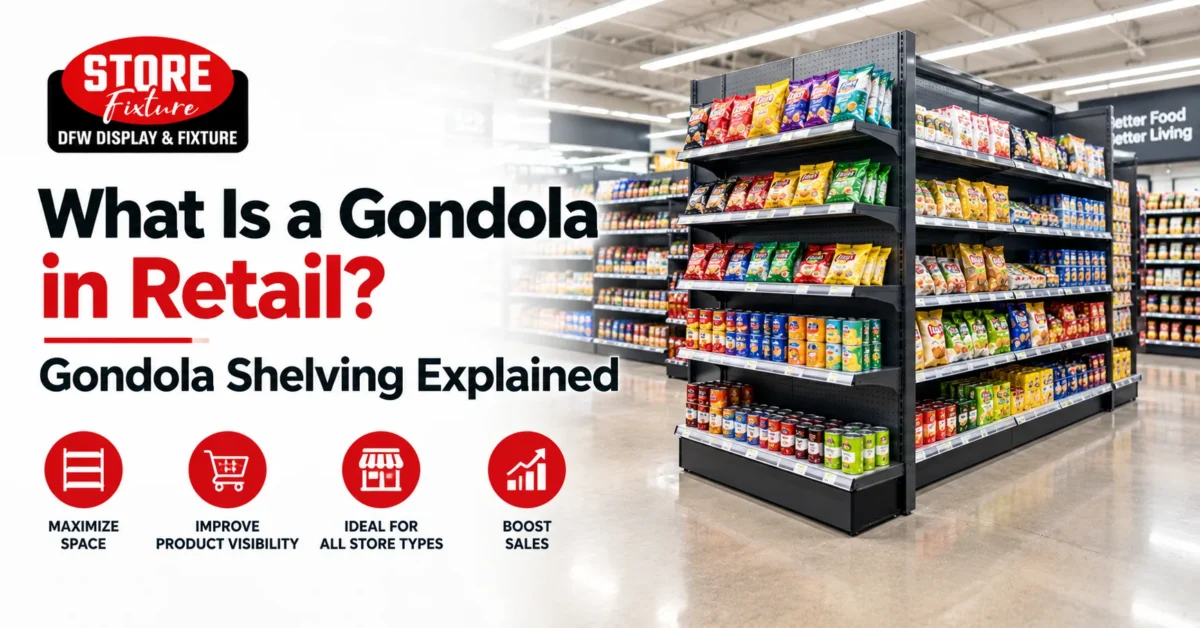
What is a gondola in retail? A gondola is a free-standing shelving unit with a flat base, upright columns and adjustable shelves, used to display products on the sales floor. Gondolas can stand alone or be joined in long runs to form the aisles you walk down in almost every grocery store, convenience store, pharmacy and hardware store.
The term covers both the single unit and the system behind it, which is why you will hear gondola, gondola shelving and gondola rack used for the same fixture. Gondola shelving is popular because it is modular. Shelves, hooks and accessories clip into slotted uprights, so a store can change its layout and product mix without buying new fixtures.
This guide explains what a gondola in a retail store is, the parts that make up a unit, the main types, how stores merchandise on gondolas and how to choose sizes for your own space.
What Is a Gondola in a Retail Store?
In a retail store, a gondola is the main fixture used to build aisles and shelving runs on the shop floor. It holds most of the packaged products customers pick up themselves: snacks, canned goods, household items, health and beauty products, auto parts and more.
Three features define gondola shelving:
- A flat, weighted base that lets the unit stand on its own without being fixed to a wall.
- Slotted uprights that allow shelves and accessories to be moved up or down in small steps.
- A back panel that separates the two sides of a double-sided unit and can hold pegboard hooks or other accessories.
A gondola can be single-sided, placed against a wall, or double-sided, placed in the middle of the floor so customers can shop from both sides. When several sections are bolted together and finished with end caps, they create a full store aisle.
What Is Gondola Shelving Made Of?
Most gondola shelving is made of powder-coated steel. The powder coat protects against scratches and rust and comes in standard colors such as white, black and almond, with chrome or other finishes on some accessories. Steel is used because it carries heavy loads, resists damage from carts and lasts for many years on a busy shop floor.
The Parts of a Gondola Unit
Knowing the parts helps you order the right components and understand a supplier's quote.
- Base deck or base shelf: the bottom shelf that sits just above the floor and adds stability.
- Base brackets and legs: support the base deck and set its depth.
- Kick plate: the front panel along the bottom that hides the base and protects it from mop buckets and carts.
- Uprights: vertical slotted columns that carry the weight of every shelf above.
- Back panels: solid, perforated (pegboard) or slotted panels that fill the space between uprights.
- Shelves and shelf brackets: removable shelves that hook into the uprights at the height you choose.
- End caps: shorter sections at the end of an aisle run, facing the main walkway.
- Accessories: pegboard hooks, shelf dividers, wire fences, price channels, sign holders and baskets.
| Tier | Rack model | Facing capacity | Price | Payback |
|---|
Types of Gondola Shelving
Different store layouts call for different gondola styles. Most stores use a combination.
Wall Gondolas
Single-sided units placed against the perimeter walls of the store. They are usually taller than island units because customers do not need to see over them. Wall gondola runs make good use of space that would otherwise be empty.
Island or Aisle Gondolas
Double-sided units that form aisles in the center of the floor. Aisle gondola shelving is often kept shorter, so customers can see across the store and staff can keep an eye on the floor.
End Caps
Short units placed at the end of an aisle run. End caps face the main traffic path, so stores use them for promotions, seasonal items and new products. They are some of the most valuable display spaces in a store.
Light-Duty and Heavy-Duty Gondolas
Light-duty gondola shelving suits lighter products such as snacks, cosmetics and small packaged goods. Heavy-duty gondolas use thicker steel and stronger uprights for canned goods, beverages, hardware and bulk stock.
Specialty Configurations
Some stores use gondolas with angled top shelves, built-in lighting, wire baskets for loose items or extra-deep bases for large products. These are usually standard gondolas fitted with specific accessories.
How Stores Merchandise on Gondolas
The flexibility of gondola shelving comes from what you can attach to it.
Shelves
Flat shelves are the most common setup. Each shelf can be set at the height that suits the product, so a single section can hold tall bottles at the bottom and small packets at eye level.
Pegboard and Hooks
Pegboard back panels accept hooks for hanging products such as batteries, phone accessories, snacks in clip strips and small tools. Pegboard hooks come in different lengths and styles, including scanner hooks with a label plate on the end.
Fences, Dividers and Pushers
Wire fences stop products from sliding off the front of a shelf. Dividers keep facings neat. Pushers move products forward as the front item is taken, so shelves always look full.
Signage and Price Channels
Price channels along the shelf edge hold labels. Sign holders and header cards mark categories and promotions so customers can find what they are looking for quickly.
What Is a Gondola in Retail Space Planning?
In space planning, the gondola is also a unit of measurement. Retailers plan their shelves in sections and linear feet, and a planogram, the diagram that shows exactly where every product sits, is usually drawn one gondola section at a time.
A typical planogram for a 4-foot gondola section shows:
- Shelf heights for each level in that section.
- Facings, meaning how many units of each product sit side by side at the front.
- Product placement by height: best sellers and high-margin items at eye level, larger and heavier items on the base deck, and children's products lower down.
- Pegboard positions for hanging items, with hook lengths matched to how many units each hook holds.
Because gondola shelving is built from standard widths, a planogram designed for one store can be copied across others with the same fixtures. Suppliers and brands often provide planograms for their products, measured in gondola sections. Even a single independent store benefits from planning this way, since it shows how much shelf space each category earns compared with the sales it brings in.
How Big Is a Gondola?
Gondola shelving is built in standard sizes, which makes it easy to plan a layout and add sections later. Exact sizes vary by manufacturer, but these are common:
- Section widths: usually 3 feet or 4 feet per section.
- Heights: commonly 48, 54, 60, 66, 72 and 84 inches. Island units are often 48 to 60 inches; wall units are often 72 inches or taller.
- Base depths: often from about 13 to 24 inches, depending on the product size.
- Shelf depths: typically 10 to 24 inches.
Shorter island gondolas keep sight lines open across the store. Taller wall units add storage capacity where visibility is not an issue.
Where Gondolas Are Used
Gondola shelving appears in almost every type of self-service store:
- Convenience stores: compact aisles for snacks, candy, automotive and household goods.
- Grocery stores and supermarkets: long runs of heavy-duty gondolas for dry goods and canned food.
- Pharmacies: health, beauty and over-the-counter products on shelves and pegboard.
- Hardware and auto parts stores: heavy-duty shelving and pegboard hooks for tools and parts.
- Dollar and discount stores: dense aisle layouts to display a wide range of low-cost products.
- Liquor stores: heavy-duty sections to hold bottles safely.
Gondola Shelving vs Other Retail Fixtures
Gondolas are not the only option. Here is how they compare:
- Slatwall: wall-mounted panels with horizontal grooves for hooks, shelves and faceouts. Slatwall suits apparel, accessories and boutique displays. Slatwall panels and fixtures look more decorative but need a wall to mount on.
- Gridwall: steel grid panels that can stand alone or mount on walls. Lighter and more flexible, but they hold less weight than gondola shelving.
- Display tables: good for featured products and promotions but limited in capacity.
- Warehouse racking: carries far more weight but is not designed for customer-facing displays.
For most self-service stores, gondola shelving offers the best balance of capacity, flexibility and cost.
Planning a Gondola Layout
Before ordering gondola shelving, plan where each run will go:
- Measure the floor, including doors, columns, coolers and checkout counters.
- Set aisle widths. Leave enough space for carts, wheelchairs and two-way traffic. Check local accessibility rules for minimum widths.
- Choose heights. Use shorter units in the center and taller units on walls.
- Map product categories. Put high-demand items toward the back so customers pass other products on the way.
- Plan end caps for promotions facing the main walkway.
- Count sections. Divide each run by your section width to work out how many units and end caps you need.
For a step-by-step approach, read our guide on how to plan your store aisle layout with gondola shelving.
Assembly Basics
Gondola shelving is designed to be assembled without welding. Uprights bolt to base brackets, back panels drop into place, the base deck and kick plate attach at the bottom and shelves hook into the slots. Sections join through shared uprights, so a run of several units goes together quickly. Always level each section and anchor tall wall units as recommended.
Keeping Gondolas in Good Condition
Gondola shelving lasts for years with simple care:
- Wipe shelves and back panels regularly with a mild cleaner, avoiding abrasive pads that scratch the powder coat.
- Replace bent shelf brackets and damaged kick plates promptly, since they weaken the section.
- Check that heavy items sit on the lower shelves and that no shelf is loaded past its rated capacity.
- Re-level units after moving them or if the floor settles.
- Keep spare shelves and hooks on hand so layout changes do not have to wait for an order.
Buying Gondola Shelving in Dallas
DFW Display & Fixture supplies gondola shelving for convenience stores, grocery stores, pharmacies, liquor stores and other retailers, from wall and aisle units to shelves, pegboard hooks and fences. Browse our full gondola shelving range, or read the gondola shelving buying guide for help choosing sizes and accessories.
Planning a new store or a refit? Visit our showroom at 10793 Harry Hines Blvd #120, Dallas, TX 75220, Monday to Saturday, 9 AM to 6 PM, or call 361-339-0323 to talk through your layout. We ship across the United States.
Frequently Asked Questions
What height of gondola works best in a convenience store?
Many convenience stores use island gondolas around 48 to 60 inches tall so staff at the counter can see across the floor, with taller units of 72 inches or more along the walls. The right choice depends on your floor size, sight lines and how much stock you need on display.
Is a gondola the same as an aisle?
Not quite. The gondola is the fixture, and an aisle is the walkway formed between two runs of gondolas. One aisle is usually lined by gondola shelving on both sides.
What is the difference between a gondola and a shelf?
A shelf is a single flat surface. A gondola is the complete fixture: base, uprights, back panel and several adjustable shelves or hooks working together.
Is gondola shelving the same as a gondola rack?
Yes. Gondola rack, gondola shelving and gondola unit all refer to the same type of free-standing, adjustable retail fixture.
How much weight can gondola shelving hold?
It depends on the shelf depth, steel gauge and whether the unit is light-duty or heavy-duty. Check the rated capacity of each shelf and spread heavy items evenly across the shelf.
Can gondola shelving be moved?
Yes. Units can be unloaded, disconnected and moved to a new layout. The modular design is one reason stores choose gondola shelving.
What is an end cap on a gondola?
An end cap is a short gondola unit at the end of an aisle run. It faces the main walkway and is used for promotions and high-margin items.