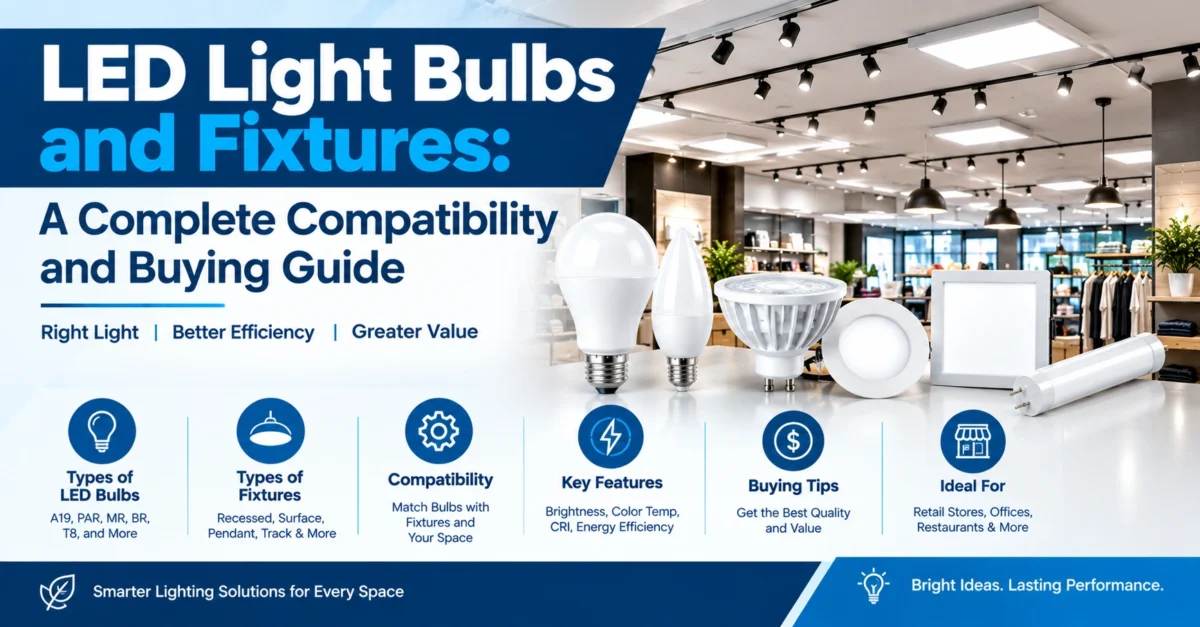
This guide is written for retail, foodservice, and facilities buyers dealing with real commercial spaces: a stockroom that needs a shop light, a storefront that needs weatherproof exterior lighting, or an older building still running fluorescent tubes. It is not a roundup of decorative kitchen or bedroom lighting. It covers what a bulb is versus what a fixture is, the fixture types a commercial buyer actually runs into, whether any LED bulb works in a sealed housing, how a fluorescent-to-LED switch works, and what to do when a fixture starts acting up.
LED Light Bulbs and Fixtures: What's the Difference?
A bulb is the replaceable light source, the part that screws, twists, or plugs into a socket and is the piece you swap out when it fails. A fixture, sometimes called a luminaire, an electrical fixture, or an electric fixture in trade listings, is everything around it: the housing, the wiring, the socket, and often a reflector or lens that shapes where the light goes. When people search for led light bulbs and fixtures, or the closely related led bulb light fixtures, they are usually trying to sort out which of the two, or both, they actually need to buy or replace.
Not every LED product splits neatly into those two parts. Many modern LED fixtures are integrated, meaning the LED chips are built directly into the housing with no separate bulb to remove. When an integrated fixture reaches the end of its life, the entire unit gets replaced rather than a bulb inside it. Outdoor flood lights, wall packs, and illuminated sign fixtures are commonly built this way, since a sealed, one-piece unit holds up better against weather and continuous commercial use than a housing with a separate bulb and socket.
Types of LED Fixtures You'll Run Into
Commercial buyers tend to deal with a handful of recurring fixture categories. Knowing which one applies narrows down everything else, from bulb compatibility to expected lifespan.
Shop and Utility Light Fixtures
Shop light fixtures, typically sold as linear led shop light fixtures in 4-foot and 8-foot lengths, are the standard choice for stockrooms, garages, and back-of-house commercial space. An 8 foot led shop light fixture is the common pick for a full stockroom or garage bay, while the 4-foot version suits a smaller space. They are usually surface-mounted or hung from chains and built for continuous use rather than the occasional on-off cycle of a household fixture.
Outdoor and Exterior Fixtures
Outdoor led light fixtures have to deal with rain, dust, temperature swings, and UV exposure, which is why weatherproofing matters more here than almost anywhere else in a building, and why led lights for outdoor fixtures carry different ratings than indoor bulbs. Store Display Fixture's exterior LED fixtures carry an IP65 weatherproof rating, a wide-angle beam that covers parking areas and storefronts evenly, and a surface-mount housing built for a facade rather than an interior ceiling. Real examples from that lineup show the range a storefront typically needs: a 50-watt flood light runs $55, an 80-watt flood light runs $79, a 300-watt pole light for larger lots runs $169, and smaller options like a 20-watt mini wall pack or a 2x2 LED panel light start at $29.
| Fixture | Wattage | Price |
| Mini Wall Pack | 20W | $29 |
| LED Panel Light 2x2 | - | $29 |
| LED Flood Light | 50W | $55 |
| LED Flood Light | 80W | $79 |
| Pole Light | 300W | $169 |
Whatever the source, the best led light bulbs for outdoor fixtures share the same baseline: a stated weatherproof rating and a lumen output matched to the area being lit, not just a low price.
Commercial and Industrial Fixtures
Commercial and industrial LED lighting covers everything from a small retail sales floor to a full warehouse, and it is generally built to higher lumen output and longer duty cycles than a residential fixture. This is also where commercial led lighting, industrial led lighting, and shop light fixtures overlap: the line between them is less about the fixture's shape and more about the space and hours it is expected to run. Specifying the right led lighting fixture, or comparing led light fixtures and housing options, at this scale comes down to lumen output and duty cycle more than wattage or brand alone.
Retail Display and Merchandising Fixtures
Retail spaces have a lighting need the categories above do not fully cover: making the merchandise itself look good. LED lighting for retail displays typically means strip lights, under-shelf lighting, cabinet lights, puck lights, and spotlights built into or mounted onto shelving and display cases, aimed at product visibility rather than general room illumination. A large part of that same category is illuminated signage. Its LED sign fixtures alone run well over a hundred products, from open signs to shaped neon-style signage, built with a slim profile frame and wall or ceiling mount options.
Can You Put Any LED Bulb in an Enclosed Fixture?
No, not automatically. Led bulbs for enclosed fixtures have to be rated specifically for that kind of housing. A standard bulb relies on airflow around its base to move heat away from its driver electronics, and a sealed fixture traps that heat instead of venting it. The same caution applies to led bulbs in an enclosed fixture and to led light bulbs for enclosed fixtures generally: if the rating isn't stated on the packaging, don't assume it's safe to install there.
Recessed ceiling cans, sealed outdoor wall lanterns, and glass-covered vanity fixtures are the most common enclosed housings a buyer runs into, and led lights for enclosed fixtures are sold specifically to handle the heat they trap. Installing a bulb that isn't enclosed-fixture rated will not usually cause an immediate failure, but the trapped heat shortens the bulb's working life and can trigger early dimming or flickering well before its rated hours are up. Checking the spec sheet for that rating before installing is the simple way to avoid the problem. This is one area where Store Display Fixture's own outdoor and commercial lighting sidesteps the question rather than needing you to solve it: those fixtures are sold as complete, IP65-rated sealed units engineered to run enclosed and outdoors from the factory, so there is no separate bulb-compatibility decision to make on them.
Replace a Fluorescent Light Fixture with LED
There are two ways to replace a fluorescent light fixture with LED, and picking the wrong one for the situation is the most common mistake in a retrofit: an led tube to fixture conversion, or swapping the whole housing.
- Tube swap: LED tubes for fluorescent fixtures, most commonly in the standard T8 light fixtures format (also listed as a T8 lamp or T8 bulb fixture), replace the fluorescent tube while the existing housing stays in place. Some LED bulbs for fluorescent fixtures are designed to work with the fixture's existing ballast; others require the ballast to be bypassed and the tube wired directly to line voltage.
- Full fixture replacement: the entire fluorescent housing comes out and a new integrated LED fixture goes in. This costs more upfront than a tube swap but removes the ballast entirely, so there is nothing left in the fixture that can fail independently of the LED itself.
A single tube swap makes sense for a fixture that is otherwise in good shape and just needs modern lighting. A full fixture replacement is worth the extra cost when the housing is old, the ballast has already failed once, or the space is due for a broader lighting upgrade anyway. An electrician can confirm which wiring situation a given fixture is in before any tubes are ordered.
| Tier | Rack model | Facing capacity | Price | Payback |
|---|
Troubleshooting LED Fixture Flickering, Lifespan, and Replacement
LED fixture flickering, sometimes described as led light fixture flickering, almost always traces back to one of a few causes: a dimmer switch that was not built for LED loads, a loose connection at the fixture or the bulb base, a failing driver inside the fixture, or voltage fluctuation on that circuit. Swapping in a known-good bulb is the fastest way to narrow it down: if the flicker follows the bulb to a different fixture, the bulb is the problem; if it stays behind, the fixture or its wiring is.
Lifespan is where LED genuinely outperforms older technology. Fixtures rated for 50,000-plus hours, the rating Store Display Fixture lists on both its exterior lighting and its LED sign fixtures, translate to well over a decade of typical commercial operating hours before replacement is expected. When a fixture is flickering, dimming, or discoloring well short of that mark, and a known-good bulb does not fix it, the fixture itself, not the bulb, is usually what needs replacing. At that point it's led fixture replacement territory rather than a simple bulb swap, and for an integrated unit, led light fixture replacement means swapping the entire sealed housing.
Features Worth Checking Before You Buy
A dimmable led light fixture, or a dimmable led fixture paired with a separate dimmable bulb, both need a dimmer switch built for LED loads. An LED bulb rated as dimmable, installed on an old dimmer designed for incandescent bulbs, is one of the more common causes of the same buzzing or flickering problem covered above. When dimming is part of the plan, confirming that the bulb, the fixture, and the dimmer switch are all rated to work together avoids a return trip to the supplier.
Standard Fixtures vs. Custom Builds for Your Business
Most commercial lighting needs are covered by a standard, in-stock fixture: a flood light for a parking area, a wall pack for a back entrance, a shop light for a stockroom. the outdoor and commercial fixtures in that lineup cover that range, from a $29 mini wall pack up to a 300-watt pole light for larger lots, all sold as complete, weatherproof, factory-sealed units.
A different question applies when the actual need is not general illumination at all but drawing attention to the storefront itself. That is a signage decision rather than a lighting decision, and it points toward the site's sign fixture catalog, built with custom message capability and slim-profile frames for wall or ceiling mounting, rather than the flood lights and panel lights covered earlier in this guide.
Store Display Fixture operates from a Dallas, TX showroom with an A+ Better Business Bureau rating and offers wholesale pricing on both standard and custom fixture orders, for a single storefront or a multi-location buildout.
Conclusion
Sorting out led light bulbs and fixtures comes down to a short list of questions: is this an enclosed housing that needs a rated bulb, is this an old fluorescent fixture worth converting or replacing outright, and is the current problem coming from the bulb or from the fixture itself. Answer those correctly and the rest, choosing the right shop light, outdoor fixture, or commercial unit, is a matter of matching the fixture to the space.
For fixtures built to remove that guesswork entirely, sealed, weatherproof, and rated for 50,000-plus hours, see Store Display Fixture's exterior and commercial fixtures or its illuminated sign fixtures for storefront signage. Contact the Dallas, TX showroom at (361) 339-0323 or through the contact page for wholesale pricing on standard or custom fixture orders.
Frequently asked questions
What's the difference between a light bulb and a light fixture?
A bulb is the replaceable light source that screws or plugs into a socket. A fixture is the housing, wiring, and socket around it. Some LED fixtures are integrated, meaning the LED is built into the housing with no separate bulb to replace.
Can you use regular LED bulbs in an enclosed fixture?
Not reliably. An enclosed fixture traps heat that a standard bulb needs airflow to shed, so only bulbs explicitly rated for enclosed use should go into a sealed housing.
What happens if you use a non-enclosed-rated LED bulb in a sealed fixture?
The trapped heat typically shortens the bulb's working life and can cause early dimming or flickering well before its rated hours are reached, rather than causing an immediate failure.
Can I replace a fluorescent tube with an LED tube without changing the fixture?
Often, yes. Some LED tubes work with the fixture's existing ballast, so only the tube needs to change. Others require the ballast to be bypassed and the tube wired directly, which is a different installation and should be confirmed before ordering tubes.
Do I need to bypass the ballast to install LED tubes?
It depends on the specific LED tube. Ballast-compatible tubes do not require bypassing; ballast-bypass tubes do, and installing the wrong type for the fixture's wiring will not work correctly.
Why does my LED fixture flicker?
The most common causes are an incompatible dimmer switch, a loose connection, a failing driver inside the fixture, or voltage fluctuation on the circuit. Swapping in a known-good bulb helps determine whether the bulb or the fixture is at fault.
How long do LED light fixtures typically last?
Commercial-grade LED fixtures are commonly rated for 50,000 or more hours of use, which is well over a decade of typical commercial operating hours before replacement is expected.
Should I replace just the bulb or the entire fixture?
If a known-good bulb resolves the issue, only the bulb needed replacing. If the problem persists across bulbs, or the fixture is an integrated unit with no separate bulb, the fixture itself needs to be replaced.
Do dimmable LED bulbs work in any fixture?
Only when the bulb, the fixture, and the dimmer switch are all rated for LED dimming. Pairing a dimmable LED bulb with an older dimmer built for incandescent bulbs is a common cause of flickering or buzzing.